Showing posts with label customer value. Show all posts

Monday, February 15, 2010

Rethinking about Reorganizing

Silos block us from thinking in a coordinated fashion about our customers, says author Ranjay Gulati. I had the pleasure of talking with him about his new book Reorganize for Resilience. It's one part common sense and 99 parts practical advice on how to break down silos and focus on integrated solutions that drive customer value.

Specifically, Gulati writes about five levers we can pull to reorganize ourselves for resilience:
  1. Coordination
  2. Cooperation
  3. Clout
  4. Capabilities
  5. Connections

Gulati also said in my interview with him that sometimes customers can't always articulate what they want, but that is where our creative efforts should be. I was struck by this statement in terms of how non profits work to solve problems for people who are often so overcome by their situations that articulation of solutions is beyond their capabilities. The irony, however, is this invaluable skill employed on behalf of the populations served is often lacking when it comes to funders. Funding organizations and peoples have problems too that need to be solved -- albeit different ones. Helping them to articulate their needs in terms of ROI for support is essential in driving up participation and dollar amounts.

What donor problems have you uncovered? What have been your solutions? Did you have to breakdown any organizational silos in your non profit or the donating org to get a solution in place?


-- David Kinard, PCM

Saturday, February 6, 2010

Go Back and Change Someone's Mind

I've had the chance to interview Jack Trout three times in my career. The first time I was working to get him to come to Seattle and speak to my chapter of the American Marketing Association. The second time was when we talked about his (then) new book In Search of the Obvious. This time, I spoke with Jack about his latest book -- one that revisits his seminal work of nearly 30 years ago.

While positioning was all about the battle for the mind, Repositioning is about adjusting those perceptions once they've been made. He liberally uses the examples of Mac versus the PC -- how Mac changed the argument from one of technology to the type of person you wanted to be. This is just one of the three keys he mentions: competition, change, and crisis.

Trout spends a lot of time talking about the difference between value and price -- and how they're not the same thing. While that may seem obvious, it isn't common practice. What stirs someone to want to make an investment into a product -- to find that there is something special in that product or service? Trout says it's about repositioning your argument based on what they're telling you.

While this may seem tried and true Trout, you're right. Trout has been selling the same choir book for more than 30 years now, but it is so fundamental and so truly important that the refresh is welcome. While we can learn from history, and other people's mistakes, I think we can also learn from Trout on how to set ourselves apart from the masses, and deeply entrench our value promises in the minds of our audiences.

Specific to non profits, Trout suggests that everything he's written completely relates. He goes one step further to note that not only do non profits need to get really good at what they do, but they also have to be seen as specialists. I can't agree more on these two points. Non profits must be experts at doing what they do, but they also have to be seen as niche experts and leaders -- those practitioners worthy of special consideration and funding.

-- David Kinard, PCM

Sunday, December 27, 2009

How Evolved is Your Marketing?

What has changed about today's consumer that makes meaningful marketing more relevant than previous types of marketing? What is meaningful marketing? Those are just some of the questions I asked Bob Gilbreath, chief marketing strategist at Bridge Worldwide, one of the nation's largest digital advertising agencies. He's also the author of The Next Evolution of Marketing: Connect with Your Customers by Marketing with Meaning.

In the podcast interview, I asked Bob if the evolution in marketing he writes about has been primarily driven by media consumption or by some other factor. Of course, it's a mixture of things. But after interviewing lots of people like Bob over the past five years, I think that there's a common thread of time-starved people who are controlling their media rather than merely absorbing whatever comes their way. In other words, we're all functioning with a bit of attention-deficit and therefore are looking for media that is going to fill needs rather than just time.

Gilbreath takes the ubiquitous Maslow's hierarchy of needs and transforms it into a new pyramid that is broken into three main categories. At the bottom is
Meaningful Solutions -- those marketing efforts that provide information, incentives, and services. One level up is Connections -- those marketing efforts that create entertaining experiences that are shared amongst others, along with the introduction to personalization. Finally, at the top of the pyramid is Achievement -- those marketing efforts that enable a user to learn a skill, improve their community/world, and cause-related marketing efforts.
In essence, Gilbreath's book is about the fact that marketing is evolving to the point where those companies that can improve the lives of their customers through the marketing itself will win out over those companies who simply try to buy usage and loyalty.
What does this mean to the non profit? A whole hell of a lot.

This past November, I received a gift catalog from Heifer International. It was one of the many in the mail but this one stood out amongst the others. Not because they used flashy printing or graphics, but the simple message that communicated it was the most important gift catalog in the world. That catalog became the pivot point for my Christmas giving, enabling me to gather together like minded people who contributed to a joint gift. This gift allowed several of us to make a meaningful contribution to our world -- a far more meaningful use of our money than things wrapped in plastic and cardboard boxes. And, at the end of the purchase experience, Heifer enabled me to share my experience with others (though their system could have been better in this regard).

The point is, I think people are looking for meaning, especially when it comes to their money. So, for the non profit the evolution is not to just rely on traditional direct mail and the annual fundraiser, but to CREATE meaningful experiences for those who flitter around the periphery of your organization, drawing them deeper into the core of your cause, and increasing the meaning at each step (think Gilbreath's hierarchy noted above).

How are you creating meaning in your marketing? Share your story here!

-- David Kinard, PCM

Sunday, July 5, 2009

Customer Service vs Customer Orientation

If you review the titles of customer service representatives in companies today, you’ll find some real gems: Customer Advocate, Customer Care Representative, and Customer Champion are some of my favorites. These position titles rank high on my list because I think they’re great identifiers of how companies are set up to systematically abuse and mistreat their customers.

Yes, you read it right. All too often our businesses are designed not from a customer-service perspective, but from a company-service perspective. This in mind, it is no surprise then that businesses today need advocates and champions for their customers—employees who are, by nature of their title, charged to do battle with the company on behalf of the customer.

A study a few years ago of customers that stopped doing business with a company cited the top reasons why those customers left. The number one reason, beating out all the others combined was an attitude of indifference by employees or staff. 68% of the customers who defected said they were tired of being treated like a number, or a non-person. More than two-thirds of customers said they were tired of being ignored.

This statistic has some hardcore bottom line lessons for us. If the standard statistic is true—that it takes at least five times more to obtain a new customer than to keep an existing one—businesses today are wasting billions of dollars by the simple act of not caring for their current customer base. Believe it or not, but the situation is actually worse than that. Companies today are doubling their losses by losing existing customers due to an attitude of indifference AND by spending more money to acquire new customers into a system that doesn’t work—a system that will ultimately abuse those new customers too!

Ironically enough, the solution is rather simple. Organize and design the business to meet the needs of the customer. Peter Drucker once said that “marketing is so basic that it cannot be considered a separate function. It is the whole business seen from the point of view of its final result, that is, from the customer’s point of view….Business success is not determined by the producer, but by the customer.”

Bottom line business success is achieved through sustainable customer success. To help your customers become successful, the solution begins with taking one step to change a policy or procedure that, from the customers’ perspective, is cumbersome and alienating. It's the difference between offering customer service to being customer-oriented. Service suggests you need to offer a guide to understand your rules, policies, and bureaucracy. Orientation suggests your entire organization is designed around providing customer value and removing anything and everything that stands in the way of that goal.

As you consider your own company, what feedback have you heard from your customers about how your business is set up? What would they change if they had a voice? If you don’t know, take some time this week and call five of your top customers and ask them these two simple questions: “What are the ways that we make it easy for you to be our customer?” and “In what ways do we make it difficult to be our customer?

-- David Kinard, PCM

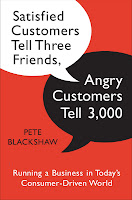
[photo credit: Pete Blackshaw]

Sunday, November 16, 2008

Fight Commoditization with Real Value

I just finished reading an amazing book by Erich Joachimsthaller, Hidden in Plain Sight: How to find and execute your company's next big growth strategy. It's a fabulous book and I'll be interviewing Erich on my radio program on Wednesday, November 19 on wsradio.com.

One line in the book hit me like a ton of bricks this weekend while I was reading it.

"We were a highly specialized product turned into a commodity."

To be clear, the line references a German insurance company who by all accounts was a superior product in the marketplace, but because people where shopping on price, none of their elaborate feature sets meant anything. I see this same situation so often; price-driven markets turning complex and highly differentiated products into commodities. So what is a markter to do?

Well, first you should read this book and it will tell you what the insurance company did. But aside from that, you need to ensure your head is not hidden in the sand, hoping that somehow consumers will suddenly wake up to your messaging and branding and agree with you that your products are truly the unique offerings you believe they are. It's never going to happen.

When a product is willingly or unwillingly turned into a commodity by the market and consumer opinion, the simple fact of the matter is that the product has failed to rise above the fray and create a demand ecosystem. In other words, I would say that most products suffering this fate are developing and pushing feature sets that are not relevant, not important, and don't resonate with consumers. That's why they're comparing only on price, because you're just as good, or good enough, as everyone else.

I think Joachimsthaller brings out many excellent ideas in his fresh book and it shoudl be required reading for MBA students. Oh wait, I teach MBA classes, and I assign the books. Guess what folks -- it's now on the reading list!

-- David Kinard, PCM

Hidden in Plain Sight is also the American Marketing Association Foundation’s Berry Book Award winner for the best new book in marketing.

Wednesday, November 12, 2008

Dim Bulb Illuminates Once-Smart Marketers' Failure

My friend Jonathan Salem Baskin, author of the popular blog The Dim Bulb, wrote yesterday about Sprint losing
another 1.3 million subscribers, and turned in a quarterly loss of $326 million. It promised to boost ad spending. Company CEO Dan Hesse said they'd "make the case for competitive pricing." He's been the spokesperson in some of the ads so far.

Baskin suggested in his blog that Sprint go out and steal some customers from AT&T and T-Mobile.

However, I would venture that just stealing customers won't fix Sprint's problems. People are leaving Sprint for the same reasons they will soon leave At&T or any other carrier -- they get bored with the brand and will flock to the next new shiny thing that comes their way. Any investment spent on stealing a customer has a tenuous long-term ROI attached to it.

Rather, I think the problem is much deeper for Sprint -- they've lost their way. They stand for "simply everything" (Sprint's new catchy slogan -- just Google "sprint simply everything to see how pervasive it is) but mean nothing. When they draw a clear line in the sand, gain the courage to do something remarkable and valuable, then I think they'll begin to solve their customer migration issues.

As usual Baskin highlight's the most absurd in big-dumb-company marketing. It is amazing how quickly once-smart people can lose their wits when they enter the corporate board room.

Monday, November 3, 2008

Meaning Matters – Adapt or Die


In 2001, the American Society of Association Executives Foundation published a seminal book on Exploring the Future. In it, authors Olson and Dighe reported on fourteen trends facing non profits, especially associations. Those trends represented seven strategic conversations that any enterprise benefits from engaging.

Charles Darwin is often attributed with the phrase, “Adapt or Die.” He was referring to the survival of the species but his comment applies to all organizations that are facing relevancy issues. And with today’s troubling economic times, those who survive will be the ones who are most effective and efficient in creating meaning for their customer communities.

Meaning matters. In the marketing world we know these words as customer value. However, there is a much richer interpretation of the words when looked at from a non-profit’s perspective – and an application of them that could mean increased customer loyalty and competitive positioning.

The competitive company will create more than just the traditional supply of products and services laden with various feature sets that are an attempt to beat out the competition. From a meaning matters perspective, the competitive company will create an opportunity for belonging and identity on behalf of the customer. Social networking sites are attempting to do this, some with more success than others. But when the formula is right, they become the enduring qualities that drive customer loyalty and create brand evangelists.

Meaning matters suggests we stop looking at our customers as transaction channels. It demands from us a perspective that treats customers as members of a community. Their payments to us are an act of investment into the community, and we then serve as stewards of those dollars. We take their investment and strive to make the community, and it’s value, richer and more meaningful to the members.

It’s a different perspective, but one that has been working for non profits and associations for more than a century now. And if you think there’s no money to be made by thinking this way – just consider the tens of billions of dollars raised every year by non profits, and the seven-figure incomes of their senior staff.

Meaning matters.

-- David Kinard, PCM

Friday, October 10, 2008

Delivering Customer Value


One of my friends got laid off today -- the economy is hitting people and companies hard. He took it well and in stride, figuring now was his opportunity to do some consulting. We chatted about how to best position himself and it reminded me of the importance of thinking in terms of delivered customer value.

In business we talk about customer value all the time. But what rarely happens is the quantifiable approach to seeing what we actually deliver. (Not to mention the fact that often what we think of as value is merely functionality and features to the customer.) This formula, originally created by marketing sage Philip Kotler, is a foundational approach to determining and delivering customer value.

The formula is easy -- each item is worth five points for a total of 20 potential points of value and cost. From a customer perspective, rate each item between 0 (zero) and five. Do the simple math of addition and subtraction and you can figure your delivered value. Now, complete the exercise with your competition in mind -- again from the customer's perspective. If you can't be objective, go out there and find some customers to do this for you. It's bare naked truth time!!

Once you have your delivered value score, well, then the real work begins to increase value and reduce costs.

-- David Kinard, PCM